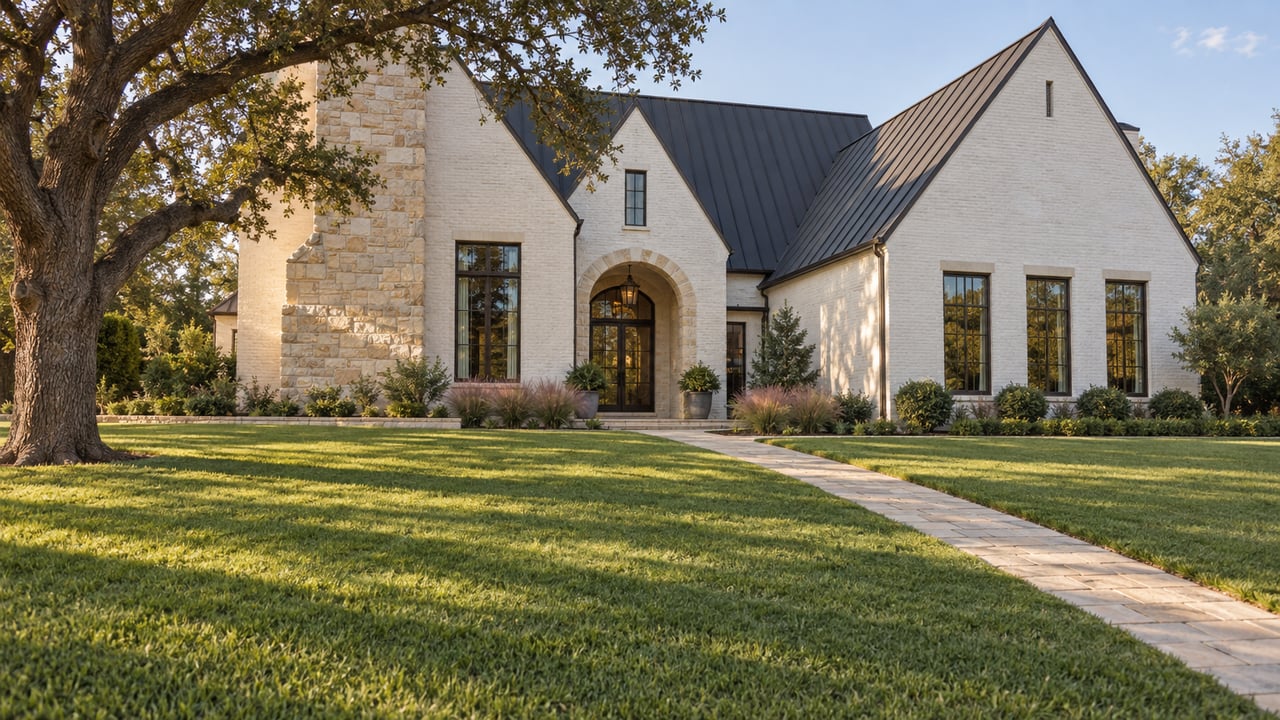
More than one relocating buyer has sent our team the same kind of message this year: four browser tabs open, four different numbers, all supposedly describing the current price of a home in Parker, Texas. Redfin's page put the median sale price near $1.0 million as of mid-2026, up 12.2% year over year, with price per square foot at $243, down 7.3% over the same stretch. Zillow's home value index showed an average of $1,109,674 as of May 2026, down 2.0% year over year. Homes.com's live listing page showed a median of $1,455,990. HAR.com stated plainly that in September 2026, the average home price in Parker is $1,802,970, with a price per square foot of $311.
The spread between the lowest and highest of those figures runs past $700,000, describing the same small town in roughly the same window of time.
None of that is a data error. It is what happens when a town this small gets measured with tools built for towns ten times its size.
The Math Behind a Six-Sale Month
Parker does not close many sales in a given month. One portal's rolling 30-day snapshot, last updated in early June 2026, counted just 6 closed sales in the prior month, down from 8 the year before, with a median of $1,254,000, a median days on market of 73, and a sale-to-list ratio of 93.88%.
Six transactions is not a market sample. It is a small committee, and its vote can swing wildly depending on who happens to show up. One $2.4 million custom estate closing alongside one $500,000 older resale can move a monthly median by hundreds of thousands of dollars, not because values shifted, but because the mix of what happened to sell that month shifted. A media room and a wine cellar in one closing, a modest older ranch house in the next, and the "median" jumps like a seesaw with only two kids on it.
That is also why a headline can read "prices up 12%" on one platform and "prices down 7%" on another in the same season. Both numbers can be accurate descriptions of what closed. Neither is describing a market with enough volume to support a clean percentage claim.
The Zip Code Parker Shares With Allen
Sample size explains part of the gap. Geography explains the rest.
Parker's addresses run through zip codes 75002 and 75094, the same codes that also cover large sections of neighboring Allen. Zip codes are postal delivery boundaries, not city limits, and some aggregators build their "Parker" statistics by pulling every closed sale inside those zip codes rather than every sale inside the town's actual boundary.
Pull up a "recently sold in Parker" results page on a major portal and you will find entries addressed "Allen, TX 75002" sitting in the same carousel as entries addressed "Parker, TX 75002." A resale on Drake Drive at $224 per square foot and a four-bedroom on Rathbone Drive near $1.1 million both get labeled Allen, both get folded into a page marketed as Parker inventory. Redfin's own "nearby sold homes" list for a Parker search mixes addresses on East Parker Road and Stafford Drive, both actually in Parker, with sales on Corinth Chapel Road and other streets labeled Allen, all inside the same 75002 code.
Parker's true acreage estates get blended with a different housing stock a few miles away, one built on smaller Allen lots at Allen prices. A single median drawn from that blend does not describe either town accurately.
Four Sources, Different Numbers, Same Season
| Source | Metric | Figure | Timeframe |
|---|---|---|---|
| Redfin | Median sale price | ~$1.0M (+12.2% YoY) | Mid-2026 |
| Redfin | Price per square foot | $243 (-7.3% YoY) | Mid-2026 |
| Zillow | Average home value | $1,109,674 (-2.0% YoY) | May 2026 |
| Homes.com | Median home price | $1,455,990 | Live listing data |
| HAR.com | Average price / price per sq ft | $1,802,970 / $311 | September 2026 |
Set side by side, the disagreement stops looking like noise and starts looking like a pattern. A buyer anchored on the lowest figure and a seller anchored on the highest are working from the same town, the same season, and completely different expectations walking into a negotiation.
Land, Not Square Footage, Is What You're Actually Pricing
Even the price-per-square-foot numbers disagree with each other for a reason beyond sample size. In a town built around acreage, square footage is not the variable doing most of the work. Land is.
Grand Homes' Kings Crossing community sits on 1 to 2 acre homesites with houses ranging from 3,450 to 8,000 square feet, priced from roughly $1.27 million to $1.34 million to start and considerably more for larger plans. Shaddock Homes builds a separate phase of the same Kings Crossing community on one-plus-acre lots along West Lucas Road, with winding creeks and wooded stretches worked into the layout. A few miles away, Whitestone Estates is a 450-acre master-planned community offering homesites from 1 to 2 acres around a central 4-acre neighborhood park, about five minutes from Lake Lavon.
None of these communities compete on interior square footage the way a standard subdivision would. A 4,500-square-foot house on a half-acre lot and a 4,500-square-foot house on a two-acre lot are not the same product, even though price-per-square-foot math treats them as identical. When a given month's closed sales happen to lean toward the larger-lot inventory, the price-per-square-foot figure can compress even as the total price paid climbs, because buyers are paying for acreage that square footage math never separates out.
What This Means If You're Comparing Parker to Lucas or Fairview
If you are cross-shopping Parker against Lucas or Fairview, the aggregator's headline number is the least useful line on the page. What actually tells you something is the comparable sale: matched on lot size, matched on build era, matched on the specific pocket of town, closed within the last few months rather than averaged across an entire zip code.
Price per acre deserves as much weight here as price per square foot, sometimes more. A house on a one-acre Kings Crossing lot and a house on a two-acre Whitestone Estates lot can carry similar floor plans with very different land costs baked into the final price. Comparing the two on square footage alone will mislead in either direction.
The workable move is to stop treating any single portal's median as a starting point for negotiation and start pulling the last several closed comparables in the specific pocket of Parker under consideration, matched on lot size and build era rather than on zip code. A market this thin on transactions rewards that kind of granular comparison and punishes anyone who walks in anchored to a number pulled from a zip-code-wide average.
Frequently Asked Questions
Why do Zillow and Redfin show different numbers for the same town? Zillow's figure is a value index built from estimated values across the broader housing stock, while Redfin reports the median of actual closed transactions in a given window. In a market with only a handful of monthly closings, those two methodologies can land far apart.
Does Parker's zip code actually include part of Allen? Zip codes are postal boundaries, not city limits. Parker's addresses fall under 75002 and 75094, and those same codes also cover parts of Allen, so a search built around zip code rather than city boundary will pull in homes outside Parker's actual town limits.
Does a lower price-per-square-foot number mean Parker is getting more affordable? Not necessarily. If more large-lot, acreage-heavy sales close in a given month, the price-per-square-foot figure can fall even as the total price paid rises, because buyers are paying for land that square footage math does not price separately.
If you are trying to figure out what a specific Parker property is actually worth against comparable listings in Lucas or Fairview, the comparison only works with real closed comps, matched on lot size and pulled street by street rather than zip code wide. The Grisak Group has spent decades pricing acreage and estate properties across these towns and can walk you through the comparables that actually apply to your search.